The math for Local Law 97 is no longer a "future risk"—it is an immediate liability. "Wake Up Call."
Here is a breakdown of the three types of penalties they face right now.
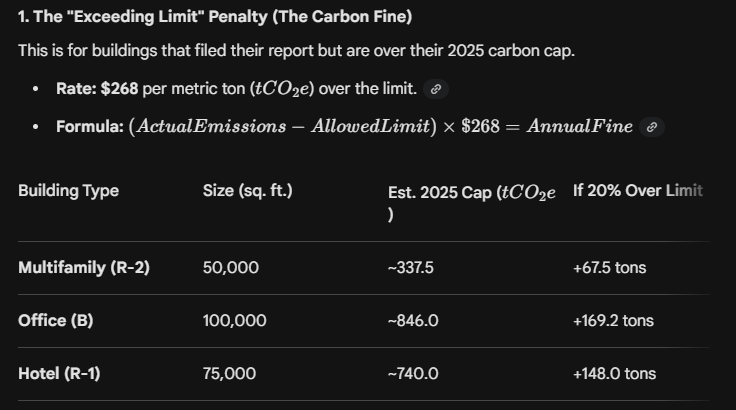
1. The "Exceeding Limit" Penalty (The Carbon Fine)
This is for buildings that filed their report but are over their 2025 carbon cap.
Rate:$268 per metric ton ($tCO_2e$) over the limit.
Formula: $(Actual Emissions - Allowed Limit) \times \$268 = Annual Fine$
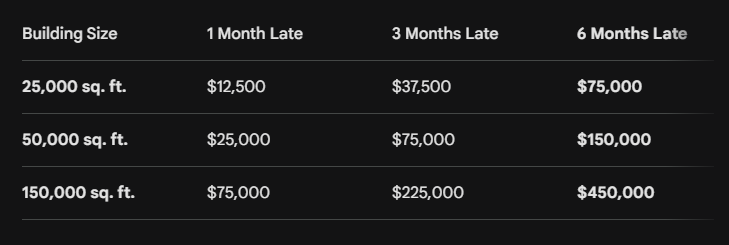
2. The "Failure to File" Penalty (The Late Fee)
This is the most "avoidable" but expensive mistake. If a developer misses the May 1st deadline (and the June 30th grace period), the fines are calculated per square foot.
Rate:$0.50 per sq. ft. per month.
Formula: $Building Size \times \$0.50 \times Months Late = Total Fine$
3. The "False Statement" Penalty (The Fraud Fine)
If a developer tries to "cook the books" or provide fake energy data to lower their score:
Flat Rate:$500,000
Note: This is why having a Registered Design Professional (RDP) sign-off is a legal shield for the developer; it puts the technical liability on the engineer's license, not the developer’s pocket.
The Allowed Limit (also called the "Emissions Intensity Limit") is calculated using two simple variables: the building’s Occupancy Group (how the building is used) and its Gross Square Footage.
The Universal Formula
$$Allowed Limit (tCO_2e) = Building Area (sq. ft.) \times Occupancy Limit Coefficient$$
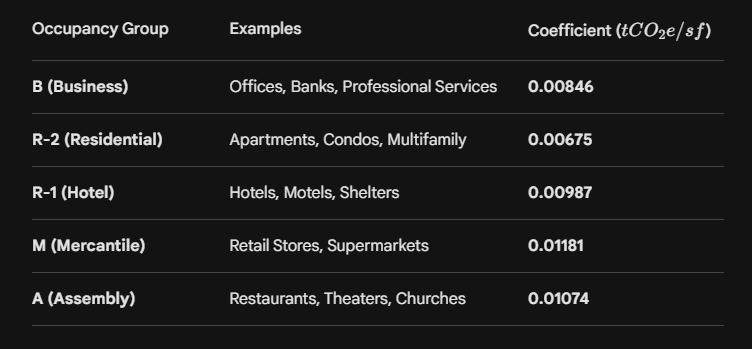
1. Occupancy Limit Coefficients (2024–2029)
The city assigns a specific number to different types of buildings. For the current period (2024–2029), these are the most common coefficients you will use for your clients:
2. Step-by-Step Calculation Example
If a developer asks you to calculate the limit for a 100,000 sq. ft. Office Building:
Identify the Area: $100,000\text{ sq. ft.}$
Identify the Coefficient: Office = Group B = 0.00846
Multiply: $100,000 \times 0.00846 = \mathbf{846.0\text{ }tCO_2e}$
This building is allowed to emit exactly 846 tons of carbon per year. If their utility bills show they emitted 900 tons, they will be fined for the 54-ton difference ($54 \times \$268 = \$14,472$).
3. Mixed-Use Buildings (Pro Tip)
Many of your NYC developers own buildings with "Retail on the ground floor, Apartments above." In this case, the limit is a weighted average:
Retail Space (5,000 sq. ft.): $5,000 \times 0.01181 = 59.05$
Apartment Space (45,000 sq. ft.): $45,000 \times 0.00675 = 303.75$
Total Allowed Limit: $\mathbf{362.8\text{ }tCO_2e}$
4. How to Find the "Actual Emissions"
To know if they are over the limit, you have to convert their utility bills into carbon using the 2024-2029 Greenhouse Gas Coefficients:
Electricity: $0.000288962\text{ }tCO_2e \text{ per kWh}$
Natural Gas: $0.00005311\text{ }tCO_2e \text{ per kBtu}$ (or ~$0.0053\text{ per therm}$)
#2 Fuel Oil: $0.00007421\text{ }tCO_2e \text{ per kBtu}$
District Steam: $0.00004493\text{ }tCO_2e \text{ per kBtu}$